

Picking the right project determines whether you spend your final semester building a working prototype or burning through microcontrollers. If you need viable Fyp Ideas for students across AI, robotics, and software engineering, you must start with hardware specifications and code architecture rather than a vague wishlist. A single mismatched UART baud rate or unhandled thread race condition can wreck a midterm demo fast.
This practical guide provides technical project concepts, scoping frameworks, and risk assessments to take your project from paper to hardware. Executing these concepts will cost you real labor. Expect long hours balancing motor driver thermal limits, refactoring backend APIs, and tracking memory leaks. In exchange, you get a clean system that meets strict academic benchmarks and survives committee grilling.
High-Impact Fyp Ideas for Students in AI and Robotics
Autonomous Mobile Robot Integration
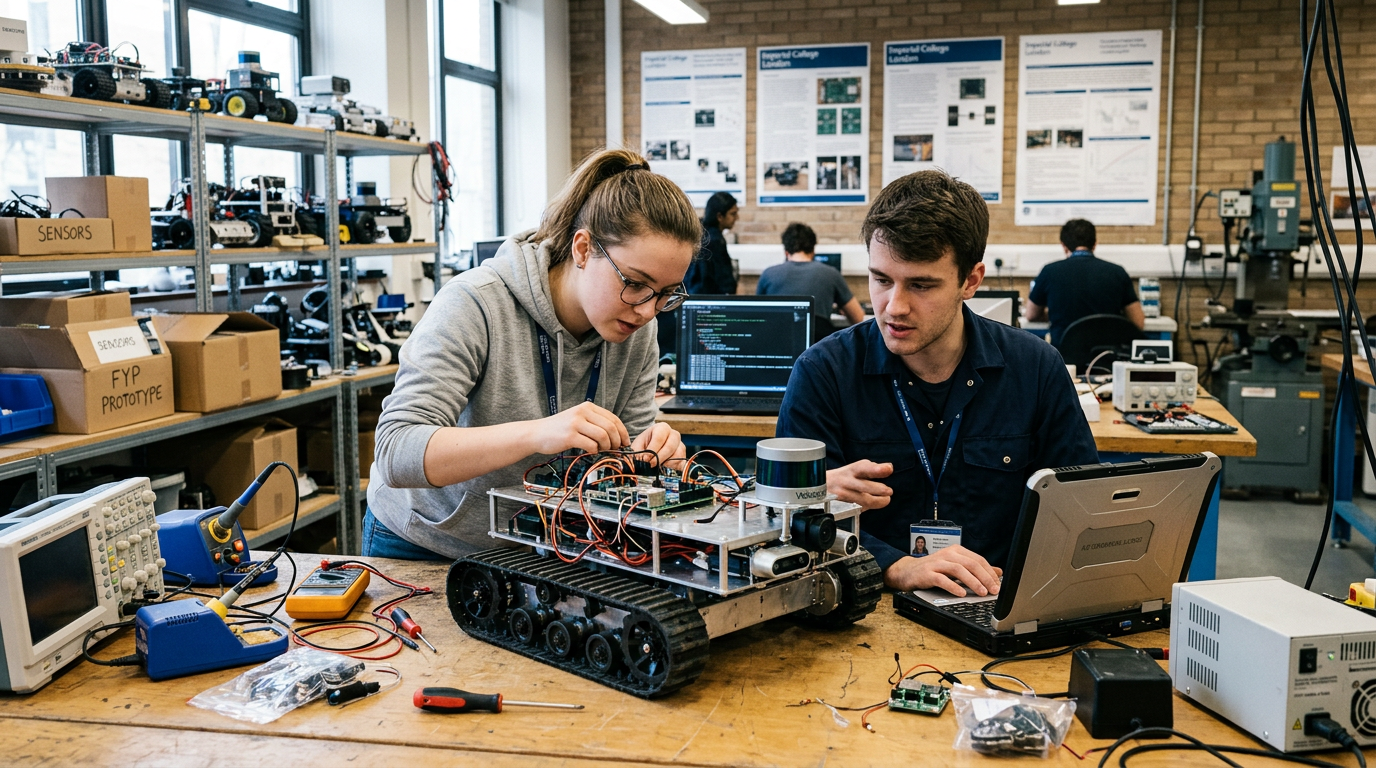
Connect ROS 2 Humble on an Nvidia Jetson Nano to a custom microcontroller over UART. A 115200 baud rate over a CP2102 USB serial bridge prevents packet loss during 50 Hz telemetry streaming. The microcontroller runs PWM motor loops and reads quadrature encoders. The Jetson executes SLAM and path planning using nav2.
Edge detection using OpenCV and TensorRT models at 1080p and 30 FPS requires setting maximum performance mode via nvpmodel -m 0. Use ROI cropping and a frame buffer queue depth of 2 to avoid RAM overload. Without active cooling fans, the GPU throttles under load, dropping inference from 28 FPS down to 4 FPS.
Bench testing reveals hardware challenges:
- Sensor noise and drift: Fuse encoder telemetry with 6-axis gyroscope IMU data using an Extended Kalman Filter via the
robot_localizationnode. - Power supply isolation: Motor start-up surges brown out the Jetson. Isolate the logic power rail using optocouplers and step-down buck converters.
- Wheel calibration: Calibrate ticks-per-meter values on a straight 5-meter test track to fix odometry before tuning ROS nav2 parameters.
Execution Roadmap and Calibration
Follow a twelve-week timeline: three weeks for mechanical fabrication and power routing, three weeks for sensor driver integration, three weeks for computer vision optimization, and three weeks for system testing. Success relies on custom hardware software integration, where physical constraints shape software architecture.
Top Computer Science and Software Engineering Project Concepts
Architectural Patterns and Category Selection
Pick an architecture that proves engineering depth without inflating scope. Multi-tenant SaaS platforms test database isolation. Distributed systems highlight concurrency and Raft consensus. Local LLM agents test vector indexing. Prioritize choices using three criteria: academic rigor, semester feasibility, and industry relevance.
| Architecture | Academic Rigor | Primary Sync Challenge | Offline Storage Need |
|---|---|---|---|
| Web Platforms | Moderate | Session state drift | Low (IndexedDB) |
| Mobile Apps | Moderate | Optimistic UI reconciliation | High (SQLite / Room) |
| Embedded IoT | High | Packet loss during drops | Critical (Flash memory) |
Edge Cases in Synchronous and Offline Systems
Failure happens at system boundaries. If your mobile app or IoT edge node uses offline storage, write explicit conflict resolution. Timestamp drift corrupts state without deterministic ordering like vector clocks or CRDTs. Expired OAuth tokens during background sync require atomic retries.
Review public computer science project repositories to inspect state management patterns. If your design requires distributed locking with only two months left, pivot. Pick isolated failure modes that are easy to defend in your viva. Gracefully handling broken sockets builds credibility with reviewers.
What to do for FYP?
You should build a practical, end-to-end system that solves a specific operational challenge using field-relevant technologies like robotics, AI, or IoT. Start by identifying a clear technical problem, defining system requirements, and creating a prototype combining hardware integration and software development. Ensuring your project delivers a functional, testable solution will help you demonstrate clear engineering capability and real-world applicability to your evaluators.
What are some good ideas for final projects?
Good final projects focus on smart automation, such as AI-driven visual inspection tools, autonomous navigation units, or IoT environmental monitoring dashboards. You should select an idea that aligns with current industry demands while matching your technical strengths in software engineering or robotics hardware. A strong project clearly demonstrates real-time data processing, hardware-software control, and measurable performance metrics.
What are some good FYP project ideas for computer science students in 2026?
Great FYP ideas for computer science students in 2026 include deployment of lightweight AI models on edge hardware, automated robotic control software, and secure IoT networks. You can build custom computer vision pipelines for quality inspection or develop real-time sensor analytics for industrial automation. Prioritize projects that demonstrate complete end-to-end software deployment, robust code architecture, and clear integration with physical systems or cloud infrastructure.
How do I choose the right final year project for my group?
You choose the right final year project by auditing your group’s collective skills in hardware, software, and AI to find a balanced challenge. Select a concept that offers clear division of tasks, ensuring every team member leads a specific component like embedded programming, algorithm design, or system integration. Confirming resource availability early prevents bottlenecks and keeps your end-to-end build on schedule for final deployment.
References and Sources


