
Standard Linux kernels introduce up to 15 milliseconds of thread scheduling jitter into ROS2 control loops, which destroys precision motor timing. Evaluating NVIDIA Jetson Orin vs ESP32 ROS2 architectures shows why splitting your robot into high-level AI vision and low-level deterministic hardware control is the only way to hit sub-millisecond execution times. If you drive PWM signals straight from a Jetson GPIO header, Linux preemption will eventually miss a cycle and twitch your actuators. You need dedicated hardware split points.
This teardown gives you the hardware wiring patterns, micro-ROS serial transport configurations, TensorRT pipeline setups, and real-world power budgets for production AMRs and university robotics projects. Implementing it costs roughly 20 hours of flashing RTOS tasks, mapping pinouts, and tuning micro-ROS ring buffers over 921600 baud UART. You will stop silent packet drops and build a clean, reliable machine.
Why Pair NVIDIA Jetson Orin vs ESP32 ROS2 in Autonomous Robots?
An NVIDIA Jetson Orin vs ESP32 ROS2 dual-tier architecture pairs heavy AI perception with deterministic real-time control. High-level path planning and vision nodes run asynchronously on Ubuntu Linux, while low-level motor drives and sensor loops execute on FreeRTOS micro-ROS with sub-millisecond precision, preventing main CPU starvation.
Running a 1 kHz motor control loop directly on Ubuntu’s standard Linux kernel introduces execution jitter exceeding 15 ms. That destroys odometry accuracy. Offloading pulse-width modulation (PWM), quadrature encoder counting, and battery telemetry to an ESP32 frees up the Orin’s ARM Cortex-A78AE cores for heavy neural networks. Micro-ROS handles deterministic scheduling on the micro-controller while ROS 2 manages complex data flow across Linux process boundaries. Setting up a stable micro-ROS interface on Jetson requires pinning your transport serial baud rate to at least 921,600 to keep transport latency minimal.
Physical separation also provides vital fault isolation. If a vision node leaks memory or crashes, your low-level hardware keeps running its internal safety loop. Custom hardware software integration services rely on this hardware split so an e-stop signal halts motor drivers within 2 milliseconds regardless of host system load. You gain hard real-time motor response without paying for expensive real-time industrial controllers. Avoid running raw motor code directly on Orin; Linux kernel scheduler preemption will eventually cause skipped steps or blown motor drivers.
| Task Domain | Compute Tier | OS Environment | Target Latency |
|---|---|---|---|
| Motor PWM & Encoders | ESP32 | FreeRTOS | < 1 ms |
| SLAM & Navigation | Jetson Orin | Linux ROS 2 | 10–50 ms |
| TensorRT Vision | Jetson Orin GPU | CUDA Engine | 5–33 ms |
| Safety & Power I/O | ESP32 | FreeRTOS | < 2 ms |
How Do Compute Architecture and Hardware Specifications Compare?
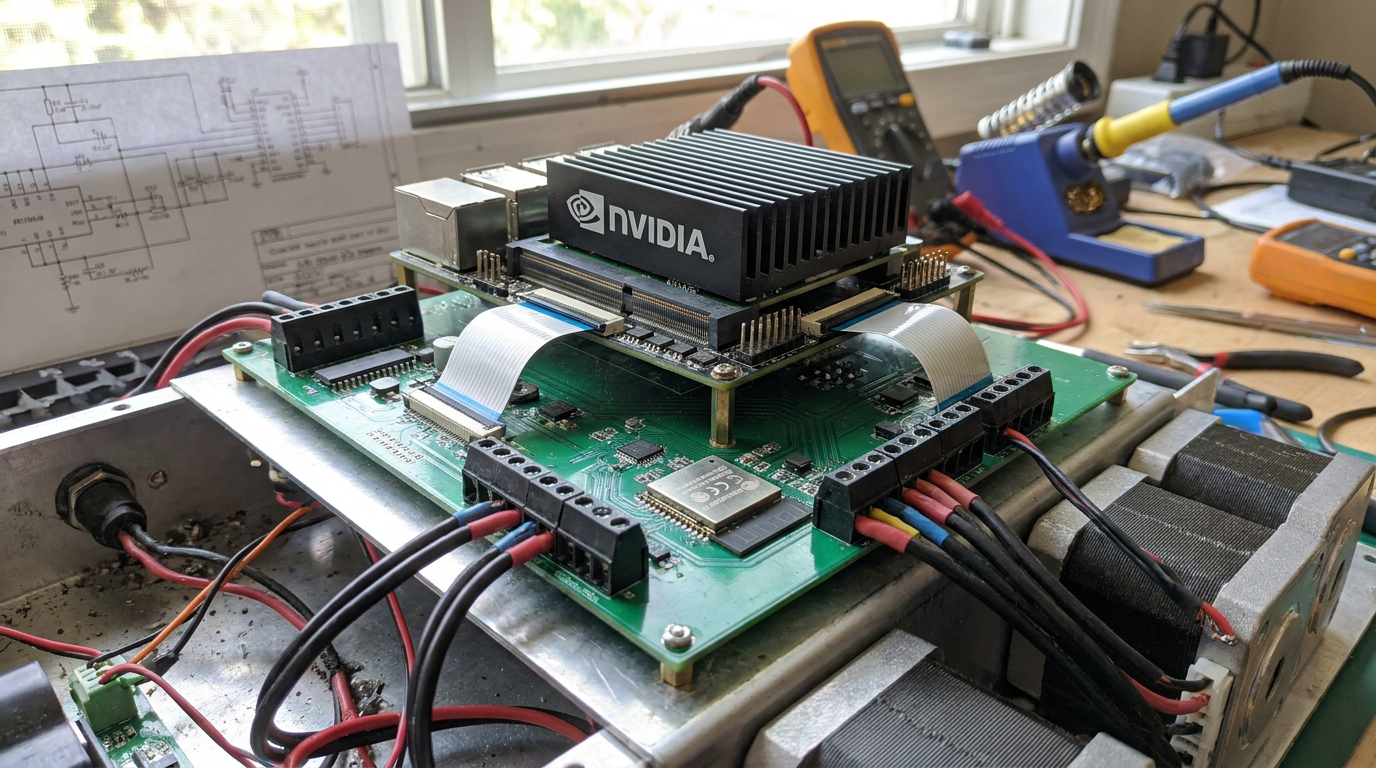
Architecture comes down to asymmetric processing. Jetson Orin provides up to 275 TOPS of AI compute via ARM Cortex-A78AE CPUs and Ampere CUDA GPUs. ESP32 delivers microsecond determinism using dual-core Xtensa or RISC-V microcontrollers at 240 MHz for sensor I/O.
Evaluating controller specifications for robotics balances throughput against determinism. Orin reaches 204 GB/s memory bandwidth on AGX models. ESP32 caps memory bandwidth under 10 MB/s but controls pin-level timing. Linux thread scheduling on Orin causes 1 ms to 10 ms jitter. ESP32 runs FreeRTOS with sub-2 µs interrupt responses. Direct Jetson GPIO motor H-bridge control risks PWM corruption from kernel preemptions. ESP32 avoids this failure mode.
Standard edge AI benchmarks on single board computers ignore boot latency. ESP32 boots under 50 ms for emergency cutoffs and encoder quadrature decoding. Orin takes 15 to 30 seconds to boot Ubuntu, initialize drivers, and launch ROS2 nodes. ESP32 handles power-up fault detection.
| Metric | NVIDIA Jetson Orin | ESP32 Microcontroller |
|---|---|---|
| CPU Architecture | ARM Cortex-A78AE (6 to 12 cores) | 32-bit Xtensa LX6/LX7 or RISC-V |
| AI Performance | 20 to 275 TOPS (Ampere GPU) | N/A (Fixed-function math only) |
| Memory & Bandwidth | Up to 64 GB LPDDR5 (204 GB/s) | 512 KB SRAM + 8 MB PSRAM (<10 MB/s) |
| Latency & Determinism | 1–10 ms jitter (Linux) | <2 µs interrupt response (FreeRTOS) |
| Boot Time | 15–30 seconds | <50 milliseconds |
How to Configure micro-ROS Serial Communication Between Jetson and ESP32?
To configure micro-ROS serial communication between an NVIDIA Jetson Orin and an ESP32, connect the hardware UART pins or an FTDI adapter, compile micro-ROS client firmware using PlatformIO, and run the micro_ros_agent on Jetson Orin at 921600 baud. This setup bridges micro-ROS nodes directly into your main ROS2 graph.
Physical Wiring and Firmware Setup
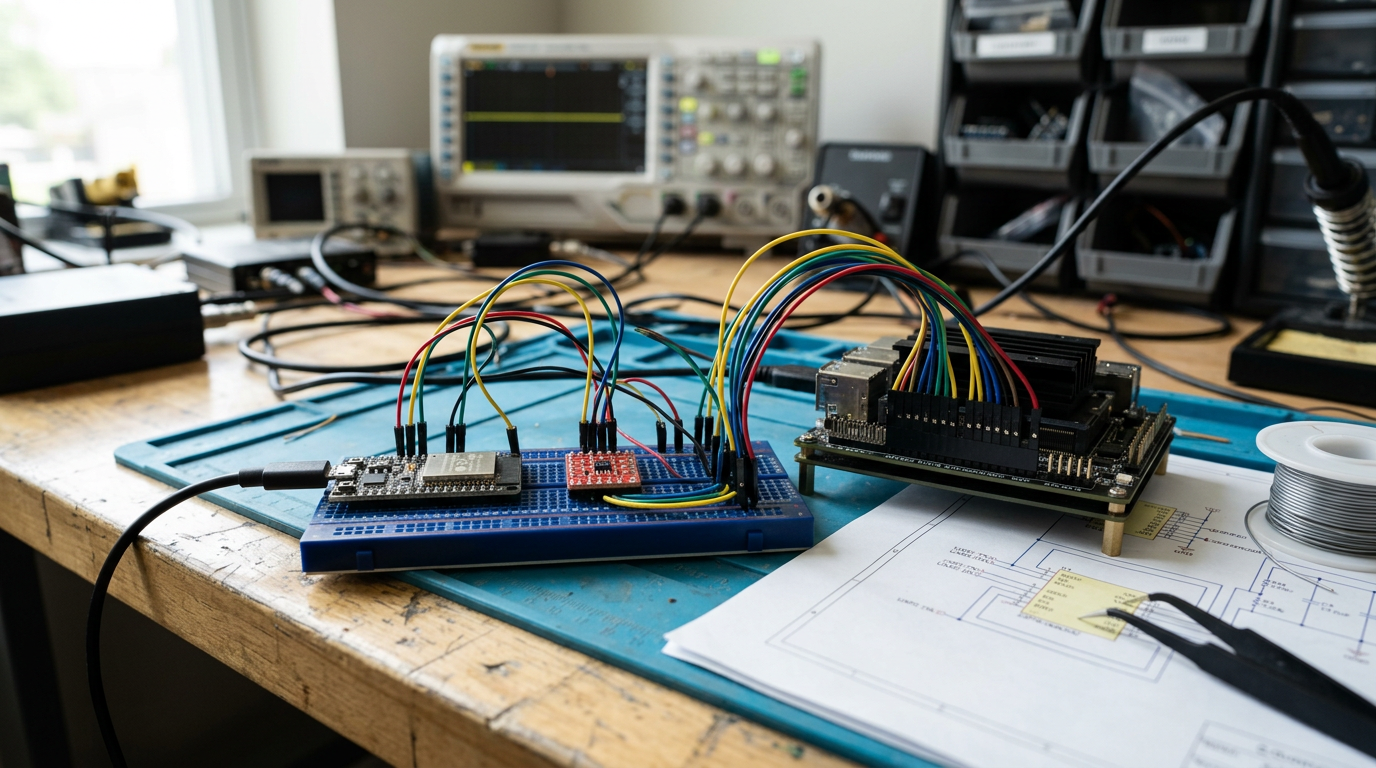
Wire ESP32 TX (GPIO17) to Jetson RX (Pin 10 / /dev/ttyTHS1) and ESP32 RX (GPIO16) to Jetson TX (Pin 8). Always share a common ground. If hardware interrupts drop frames, switch to an external FTDI USB-to-UART bridge mapped to /dev/ttyUSB0. For your micro-ROS communication UART setup in PlatformIO within VS Code, configure your platformio.ini file:
[env:esp32dev]
platform = espressif32
board = esp32dev
framework = arduino
board_microros_transport = serial
lib_deps = https://github.com/micro-ROS/micro_ros_platformio
Inside your main application sketch, call Serial2.begin(921600, SERIAL_8N1, 16, 17) before calling the micro-ROS allocation functions to ensure clean initialization.
Agent Execution and Troubleshooting
Launch the micro-ROS agent on the Jetson Orin to establish ROS2 serial communication from Jetson Orin:
docker run -it --rm --net=host --privileged -v /dev:/dev microros/micro-ros-agent:humble serial --dev /dev/ttyTHS1 -b 921600
When comparing performance in NVIDIA Jetson Orin vs ESP32 ROS2 builds, startup handshake timeouts usually point to port resource conflicts. Fix packet timeouts with this checklist:
- Disable Jetson serial console:
sudo systemctl stop nvgetty.serviceandsudo systemctl disable nvgetty.service. - Add your user to dialout:
sudo usermod -aG dialout $USER. - Confirm TX and RX lines cross cleanly between board headers.
- Match serial parameters exactly to 921600 baud, 8 data bits, no parity, 1 stop bit.
What Causes Micro-ROS Session Drops and Serial Buffer Failures?
Micro-ROS session drops and serial buffer failures stem from UART bandwidth saturation, ESP32 DMA buffer exhaustion, and signal noise. High-frequency publishers overwhelm the physical link. The micro-ROS Agent then drops transport frames, leading to silent disconnects or freezes.
Publishing IMU or encoder data above 100Hz over 115200 baud serial causes an immediate ESP32 DMA buffer overflow. At 115200 baud, raw throughput tops out around 11.5 KB/s. A single ROS 2 message payload in Micro-XRCE-DDS framing consumes 40 to 80 bytes. High sensor tick rates silently overflow the ring buffer.
Serial UART lacks physical flow control unless explicitly wired with RTS/CTS lines. Ethernet or UDP transceivers eliminate this constraint by offloading buffering to dedicated silicon. If you face a persistent issue with micro-ROS communication, check your baud rate and message size before modifying agent parameters.
To diagnose session failures, run dmesg -w | grep -i tty on the Orin to monitor serial driver frame errors and overrun flags. Check publisher stability with ros2 topic hz /your_topic. If published rates drop below target, downsample sensor loops before accelerating ROS 2 nodes on the Orin.
How Does Jetson Orin Handle High-Level ROS2 Vision Nodes and TensorRT?
The NVIDIA Jetson Orin handles high-level ROS 2 vision processing by offloading neural network inference to its Ampere GPU architecture via TensorRT engines. By deploying NVIDIA Isaac ROS packages with NvMM zero-copy memory transport, Orin processes high-resolution video streams at sub-10ms latencies, leaving real-time motor loops to downstream microcontrollers.
Zero-Copy Pipelines and Acceleration Performance
When balancing an NVIDIA Jetson Orin vs ESP32 ROS2 architecture, the Orin handles heavy spatial compute. Standard ROS 2 image pipelines choke when copying raw image messages into GPU tensors across CPU memory interfaces. A single 1080p RGB camera stream running at 60 frames per second generates roughly 350 MB/s of uncompressed pixel data. Copying this payload across system RAM repeatedly saturates memory buses and spikes latency. NVIDIA Isaac ROS eliminates this bottleneck by retaining camera frames directly in hardware-allocated memory using the nvmm transport format. Intra-process vision nodes exchange lightweight memory pointers across the DAG pipeline rather than duplicating byte arrays.
According to NVIDIA developer documentation, a Jetson Orin Nano 8GB operating at a 15W power target reaches over 140 frames per second on object detection models like YOLOv8n using TensorRT FP16 execution. Isaac ROS image segmentation and feature tracking nodes process full sensor arrays in under 4 milliseconds per frame. You can then stream target vectors over high-speed UART to control your robot using micro-ROS on an ESP32. If your robot relies on a custom PCB design for tracking devices, running vision tasks through TensorRT ensures zero frame drops on the Jetson while preserving microsecond loop timing on your low-level hardware.
What Makes ESP32 Ideal for Low-Level Motor Control and Sensor I/O?
The ESP32 excels at low-level motor control and sensor I/O by executing micro-second deterministic timing on dedicated hardware peripherals. Offloading pulse counting, PWM generation, and real-time PID loops to dedicated hardware frees high-level Linux edge processors from tight low-latency interrupt overhead that causes motor jitter.
Dedicated Motor Control PWM (MCPWM) modules and Pulse Counter (PCNT) peripherals drive this efficiency. The PCNT decodes dual-channel quadrature encoder signals directly in hardware at frequencies up to 40 MHz without CPU intervention. Dedicated GPIO hardware interrupts process edge changes instantly, preventing skipped encoder pulses during high-speed motor rotation. Pinning a wheel velocity PID loop to a dedicated FreeRTOS task on Core 1 at a 1 kHz frequency guarantees sub-millisecond execution, unaffected by background tasks.
Auxiliary peripherals handle remaining sensor I/O: SPI and I2C buses stream IMU data, while 12-bit ADC channels monitor motor driver current draw. Micro-ROS converts raw PCNT tick counts directly into nav_msgs/msg/Odometry messages before publishing over serial. In an NVIDIA Jetson Orin vs ESP32 ROS2 breakdown, this clean separation isolates real-time motor dynamics from Linux scheduler latency.
| ESP32 Hardware Peripheral | Robotic Target Function | Execution Latency |
|---|---|---|
| PCNT (Pulse Counter) | Quadrature Encoder Decoding | Hardware direct (0 µs CPU) |
| MCPWM Module | BLDC / Brushed Motor Duty Cycles | Sub-microsecond hardware switch |
| FreeRTOS Core 1 Task | 1 kHz Closed-Loop PID Control | 0.2 ms to 0.5 ms deterministic |
Whether you deploy a quadruped robot with Jetson Orin Nano compute or a basic differential mobile base, keeping microsecond timing on the microcontroller is essential. Review any modern robotics hardware integration case study to confirm: mixed-criticality design prevents Linux kernel scheduling preemptions from stalling your motor drives.
How Do You Select Between Orin Nano, Orin NX, and AGX Orin for ROS2 Systems?
Selecting the right NVIDIA Jetson Orin module depends on your ROS2 pipeline’s AI inference load, camera streams, and thermal budget. The Orin Nano handles single-camera visual odometry, the Orin NX powers multi-camera spatial AI with 3D LiDAR, and the AGX Orin runs heavy industrial multi-model vision workloads under high power envelopes.
Matching Hardware Specs to ROS2 Sensor Density
Offloading low-level actuation in an NVIDIA Jetson Orin vs ESP32 ROS2 setup keeps your Jetson dedicated strictly to heavy compute. Orin Nano (4GB/8GB) delivers 20 to 40 INT8 TOPS at a 5W–15W power draw. It handles 2D SLAM and basic object detection. Avoid the 4GB variant if you run Foxglove Studio bridges alongside OpenCV; ROS2 node memory overhead will trigger out-of-memory faults.
The Orin NX (8GB/16GB) strikes the ideal balance for mid-tier AMRs, pushing 70 to 100 TOPS within a 10W–25W envelope. It easily processes two 1080p depth streams and a 32-beam 3D LiDAR while maintaining sub-15ms node latency. For desktop evaluation vs field deployment, check a Hiwonder ROS robot kits comparison before locking in custom PCB carrier layouts.
For factory deployments detailed in an industrial robotics automation practical guide, AGX Orin offers up to 275 TOPS. Use it when running local Vision-Language Models (VLMs) alongside multi-camera GigE arrays.
| Module | CUDA Cores | INT8 TOPS | TDP Range | Recommended Sensor Payload |
|---|---|---|---|---|
| Orin Nano (4GB/8GB) | 512 – 1024 | 20 – 40 | 5W – 15W | 2D LiDAR, 1x 1080p Camera |
| Orin NX (8GB/16GB) | 1024 | 70 – 100 | 10W – 25W | 3D LiDAR, 2x Stereo Cams, IMU |
| AGX Orin (32GB/64GB) | 1792 – 2048 | 200 – 275 | 15W – 60W | Multi-GigE Cams, 3D LiDAR, Local VLM |

What Are the Real-World Power Consumption and Thermal Constraints?
NVIDIA Jetson Orin vs ESP32 ROS2 setups demand strict rail isolation. Under TensorRT inference, an Orin Nano pulls 7W to 15W, throttling above 85°C inside sealed chassis. The ESP32-WROOM-32 consumes 0.15W to 0.8W for micro-ROS serial transport and motor I/O.
Power Distribution and Thermal Mitigation
Never power an ESP32 from the Jetson USB header with high-torque motors attached; spikes collapse the 5V bus and drop micro-ROS sessions. Use dual DC-DC step-down converters: a 5V 5A buck converter for Jetson power and a 3.3V 1A buck regulator for ESP32 logic. Unvented chassis force Jetson throttling within 15 minutes without an active PWM fan. In the Runaway Mini Fridge Robot build details, thermal trapping in unvented acrylic housings caused failures during vision processing.
Power Budget for a 4-Hour AMR Shift
To run an Autonomous Mobile Robot (AMR) for four hours, calculate power budgets against thermal losses. At peak load, the Jetson consumes 60Wh (15W × 4h), the ESP32 takes 3.2Wh (0.8W × 4h), and dual drive motors need 120Wh. Adding 15% step-down efficiency loss requires a 215Wh battery pack (12.8V 17Ah LiFePO4). When testing FYP ideas for engineering students, design budgets around worst-case thermal specs, not idle claims.
| Hardware Layer | Measured Power (Idle) | Measured Power (Peak) | Thermal Limit |
|---|---|---|---|
| Jetson Orin Nano | 3.0W | 15.0W | 85°C Junction |
| ESP32-WROOM-32 | 0.15W | 0.8W | 125°C Package |
| Dual Buck System (5V/3.3V) | 0.2W | 3.5W Loss | 65°C Inductor |
How to Build a Quadruped or AMR Architecture Using Jetson and ESP32?
A split-tier AMR or quadruped architecture pairs an NVIDIA Jetson Orin for spatial computing with an ESP32 for deterministic motor execution. High-throughput depth cameras and LiDAR feed directly into Jetson Orin running Nav2, which outputs target velocity commands over hardware UART to the ESP32 for real-time kinematic control and motor actuation.
Hardware Topology and Micro-ROS Kinematics
When building an Autonomous Mobile Robot (AMR), route your sensors and compute in this explicit sequence:
- Sensors (LiDAR/Stereo Camera) connect via USB 3.2 to Jetson Orin.
- Jetson Orin runs SLAM and Nav2, outputting
geometry_msgs/msg/Twist. - micro-ROS transport sends velocity vectors over UART at 921600 baud to ESP32.
- ESP32 parses
cmd_vel, solves differential drive kinematics, and outputs PWM to motor drivers.
During assembly, tie the Jetson Orin GPIO GND pin directly to the ESP32 ground pin using a low-impedance bus bar. If you leave the grounds floating, high-frequency PWM switching corrupts serial packets, causing micro-ROS session timeouts every 12 to 15 seconds. On the ESP32, execute your inverse kinematics callback every 20ms (50Hz) to convert linear.x and angular.z into left and right wheel RPM.
For FYP students looking for viva safe hardware project ideas, verify your coordinate frames before driving. Launch rviz2, add the TF display, and inspect the transform tree from odom to base_footprint. If your published encoder odometry drifts vertically or flips during rotation, adjust the wheel track width parameter in your ESP32 firmware before attempting autonomous navigation. For step-by-step flashing scripts, review our Micro ROS and Web UI setup guide.
Does NVIDIA Jetson Orin Run Linux and Support Standard ROS2 Distributions?
Yes, NVIDIA Jetson Orin runs Linux for Tegra (L4T) and fully supports standard ROS 2 distributions. JetPack 6.x uses an Ubuntu 22.04 LTS base kernel, providing native binary support for ROS 2 Humble Hawksbill. JetPack 5.x relies on Ubuntu 20.04 LTS, requiring Docker containerization to execute ROS 2 Humble nodes reliably.
JetPack OS Lifecycles and Kernel Dependencies
NVIDIA builds JetPack on modified Ubuntu kernels. JetPack 5.1.2 uses Linux kernel 5.10 alongside Ubuntu 20.04 LTS, which natively aligns with end-of-life ROS 2 Foxy. Because ROS 2 Humble targets Ubuntu 22.04 LTS, forcing direct installation onto JetPack 5.x host systems causes severe GLIBC version conflicts. Upgrade to JetPack 6.0 instead. It works immediately. JetPack 6.0 transitions L4T to Linux kernel 5.15 and Ubuntu 22.04 LTS. You get direct apt package management for ROS 2 Humble and Jazzy desktop environments without building custom toolchains.
Docker Architecture for High-Reliability Deployments
Do not install your ROS 2 workspace directly on the host L4T system. Containers keep environments clean. The NVIDIA Container Toolkit passes host Tegra CUDA driver libraries directly into OCI containers using runtime flags. This isolation prevents graphics stack breakages when running system updates. Industrial deployments rely on this containerized approach to ensure long-term maintainability. Student FYP builds can use native installs on JetPack 6.0 to lower setup complexity. Both workflows connect to your low-level hardware efficiently, letting Jetson vision nodes pass command velocities to micro-ROS agents on ESP32 micro-controllers across serial channels during your NVIDIA Jetson Orin vs ESP32 ROS2 project build.
When Should You NOT Use a Jetson Orin and ESP32 Dual-Controller Setup?
Avoid an NVIDIA Jetson Orin vs ESP32 ROS2 dual-controller architecture if your robot relies solely on 2D LiDAR SLAM, basic teleoperation, or simple ultrasonic obstacle avoidance. Splitting tasks across micro-ROS serial links adds unwanted serialization latency (15–30 ms), software sync overhead, and extra hardware failure points when a single single-board computer handles the workload.
Single-Board Systems for Low-Complexity Kinematics
If your design skips parallel TensorRT neural networks or multi-camera spatial AI, drop the dual-board model entirely. A single Raspberry Pi 5 ($80) runs ROS 2 Humble natively. It manages differential drive kinematics and sensor I/O using direct USB-to-CAN converters without custom micro-ROS firmware. You remove UART packet dropping, memory fragmentation on embedded microcontrollers, and baud rate bottlenecks capped at 921600 bps. Simple rovers simply do not need two processors.
Firmware Maintenance Overhead and Cost Constraints
Dual-controller setups demand tight sync between desktop ROS 2 workspaces and embedded C++ codebases. Every custom ROS 2 message modification forces you to regenerate micro-ROS transport headers, rebuild client libraries, and re-flash the ESP32 through PlatformIO. A single interface mismatch breaks serial communication instantly. That introduces severe deployment friction for university FYP timelines and lean engineering teams.
Financially, paying $499 or more for an Orin Nano makes zero sense if your vision pipeline uses under 15% of its CUDA cores. If your motor control loop requires deterministic hardware interrupts under 1 ms, run a standalone micro-controller over CAN directly to a host PC. Skip the dual-controller configuration when a single single-board computer meets your processing budget.
How Do Budget and Hardware Development Costs Compare for Industry vs FYP Projects?
A dual-controller NVIDIA Jetson Orin vs ESP32 ROS2 setup costs between $550 and $2,100 per unit depending on compute choices. Split architectures cut hardware expenses by offloading low-latency motor control and sensor polling from expensive AI silicon to a $6 microcontroller, saving hundreds over single-board industrial computers.
| Deployment Tier | Core Hardware BOM | Hidden Integration Costs | Estimated Per-Unit Total |
|---|---|---|---|
| FYP Student Prototype | Jetson Orin Nano 4GB + ESP32 DevKit ($506) | $45 (Level shifters, jumper wire, buck module) | $551 |
| Small Industrial Batch (10–50 units) | Jetson Orin NX 16GB + ESP32-WROOM ($1,105) | $320 (Custom carrier board, DIN mount, isolated power) | $1,425 |
| Commercial Mass Production | Jetson Orin NX SOM + Integrated ESP32 Chip ($780) | $140 (Mass SMT assembly, industrial enclosure) | $920 |
| Single x86 SBC Alternative | Industrial Core i7 SBC + PCIe I/O Card ($2,200) | $450 (High-wattage PSU, custom wire harness) | $2,650 |
For a university Final Year Project, keeping budgets tight means using breakout boards and bi-directional 3.3V to 5V logic level converters over USB serial. Industrial builds cannot tolerate loose headers. Custom PCB runs require step-down regulators, optocouplers for noise suppression, and ESD protection chips. These added design passes increase upfront non-recurring engineering fees. But they reduce total bill-of-materials costs compared to buying overkill x86 IPCs. If your system lacks camera pipelines or spatial AI needs, don’t buy the Orin. A standalone ESP32 handles low-level ROS2 control alone.
What Are the Step-by-Step Integration Milestones for Robotic Hardware Deployment?
Deploying a robot built on an NVIDIA Jetson Orin vs ESP32 ROS2 architecture requires a strict three-phase integration pipeline: bench-testing micro-ROS serial transport topics, executing closed-loop PID motor calibration, and validating high-level SLAM stack integration. Moving systematically prevents hardware runaway, power bus brownouts, and frame drift.
Sequential Verification and Hardware Safety
Begin on the workbench. Verify micro-ROS publisher and subscriber nodes over UART or USB before attaching motor drivers to physical wheels. Configure a hardware watchdog timer on the ESP32 using a strict 50ms timeout window. If the serial stream from the Jetson drops or freezes, the ESP32 must immediately zero out PWM output signals to cut motor power.
Next, tune closed-loop motor velocity at 100 Hz on the microcontroller. Ensure encoder feedback processing takes under 2ms per cycle. Once localized velocity tracking works reliably, mount your hardware and pass control back to Jetson to test ROS2 Nav2 nodes, local costmaps, and real-time obstacle avoidance routines under actual load.
Pre-Deployment Diagnostic Checklist
Execute these terminal diagnostic checks on the Jetson before releasing your robot onto the field:
- ros2 topic hz /cmd_vel: Confirm command publishing rates sustain 20 Hz to 50 Hz continuously without lost packets.
- ros2 topic echo /odom: Verify wheel encoder calculations align with physical wheel rotation distance and direction.
- rqt_graph: Inspect active node topography to ensure no dangling nodes or unmapped subscriptions exist.
Your deployment readiness standard is met when micro-ROS session reconnections drop to zero over a 30-minute continuous run, battery voltage remains above minimum brownout thresholds under peak motor loads, and E-stop triggers cut wheel power within 10ms.
Flash micro-ROS onto your ESP32 right now and establish a dedicated serial link to your Jetson Orin at 921600 baud. Run ros2 topic echo /microROS/ping from the Orin terminal. A steady 100 Hz response without session dropouts or serial buffer overflows is your signal that the hardware transport layer works cleanly. That is your operational baseline.
This dual-controller setup will not fix bad mechanical design, uncalibrated motor encoders, or noisy power buses. Connecting high-level edge AI compute to a real-time microcontroller cannot compensate for floating ground loops or motor drivers that thermal-throttle under physical load.
If your project only requires simple differential drive and basic ultrasonic obstacle avoidance, do not bother with this architecture. A single microcontroller executing bare-metal C++ handles that workload at a fraction of the power budget. Reserve the Orin and ESP32 pairing strictly for complex platforms that genuinely demand real-time TensorRT neural networks alongside microsecond-accurate hardware control.
Frequently Asked Questions
Does NVIDIA use ROS2?
Yes, NVIDIA fully supports and actively integrates ROS 2 into its robotics ecosystem through hardware-accelerated packages called Isaac ROS. These GEMs offload heavy computational tasks like AI perception, visual SLAM, and stereo visual odometry directly onto Jetson GPU cores. This allows your autonomous robots to process high-throughput sensor data with extremely low latency.
Is Jetson better than Raspberry Pi?
NVIDIA Jetson boards outperform Raspberry Pi for heavy AI and computer vision workloads due to their dedicated CUDA-capable GPUs. While a Raspberry Pi excels at basic control tasks, low-power IoT, and simple robotics, Jetson platforms process real-time deep learning pipelines and complex ROS 2 stacks effortlessly. Your choice depends on whether your project requires high-performance neural network inference or basic sensor management.
Is the Nvidia Jetson discontinued?
No, the NVIDIA Jetson product line is active and evolving, though older developer kits like the original Jetson Nano have reached end-of-life status. NVIDIA continuously updates the lineup with newer architecture, currently focusing production on the high-performance Jetson Orin family, including Nano, NX, and AGX variants. You can safely build modern industrial or academic projects using active Orin hardware backed by ongoing software support.
Does Jetson Orin run Linux?
Yes, NVIDIA Jetson Orin runs an Ubuntu-based Linux operating system provided through the official NVIDIA JetPack SDK. This tailored Linux environment includes pre-installed CUDA, TensorRT, and cuDNN drivers required to execute deep learning models and custom software stacks. It provides you with a familiar desktop or headless terminal interface for installing ROS 2 packages and managing hardware drivers seamlessly.
How do Jetson Orin and ESP32 communicate in ROS 2?
Jetson Orin and ESP32 communicate in ROS 2 using micro-ROS running on the microcontroller connected to the main ROS 2 network over UART or Wi-Fi. The ESP32 executes light micro-ROS client nodes that handle low-level motor drivers and sensors, publishing topics to a micro-ROS Agent hosted on the Jetson. This architecture allows your high-level AI algorithms on the Orin to seamlessly send velocity commands and receive real-time telemetry from the ESP32.
References & Further Reading


