

Rumors are stabilizing into production realities. Tesla is set to open reservations for Optimus robot later this year, says indust insiders tracking the early 2026 actuator redesigns. You are likely asking if a bipedal platform actually fits your facility.
Humanoid kinematics look great on video. But managing the 500Hz control loop latency for a 28-DOF frame requires entirely new edge-compute architecture compared to a standard 6-axis SCARA.
This guide breaks down how to simulate kinematics and prepare for hardware integration. You will need to rewrite your models. Expect weeks of recalibrating safety protocols.
Why Tesla is set to open reservations for Optimus robot later this year, says indust experts?
Tesla aims to commercialize its humanoid robot by opening early reservations to lock in market share and measure demand, according to industry expert The San Francisco Standard. However, engineering bottlenecks in hand actuation and shifting capital allocations create uncertain timelines for industrial facility managers planning immediate deployments.
While reporting from industry expert The San Francisco Standard suggests reservation books open ahead of schedule, physical hardware limits tell another story. Analysis from Electrek notes Tesla pushed Optimus deliveries to late 2027 due to unresolved hand actuator problems. Humanoid hands require precise motor control under 15 ms latency and responsive tactile feedback. Standard cable-driven digits degrade rapidly under continuous 24/7 workloads. Even as coverage on tech-insider.org outlines a production line built for 1 million units per year, mechanical durability remains an unproven milestone.
Financial metrics complicate your automation planning further. A recent Bloomberg analysis showed Tesla lowered its planned capital expenditures, fueling doubt on their immediate robotics and AI production goals. If you are drafting your 2025–2026 capital expenditure budget, these conflicting timelines require clear decision criteria:
- Reserve early: Secure priority hardware slots, but risk tied-up capital if delivery dates slip into 2027 or beyond.
- Hold budget: Avoid pre-order risk, but delay acquiring actual humanoid kinematic data on your own factory floor.
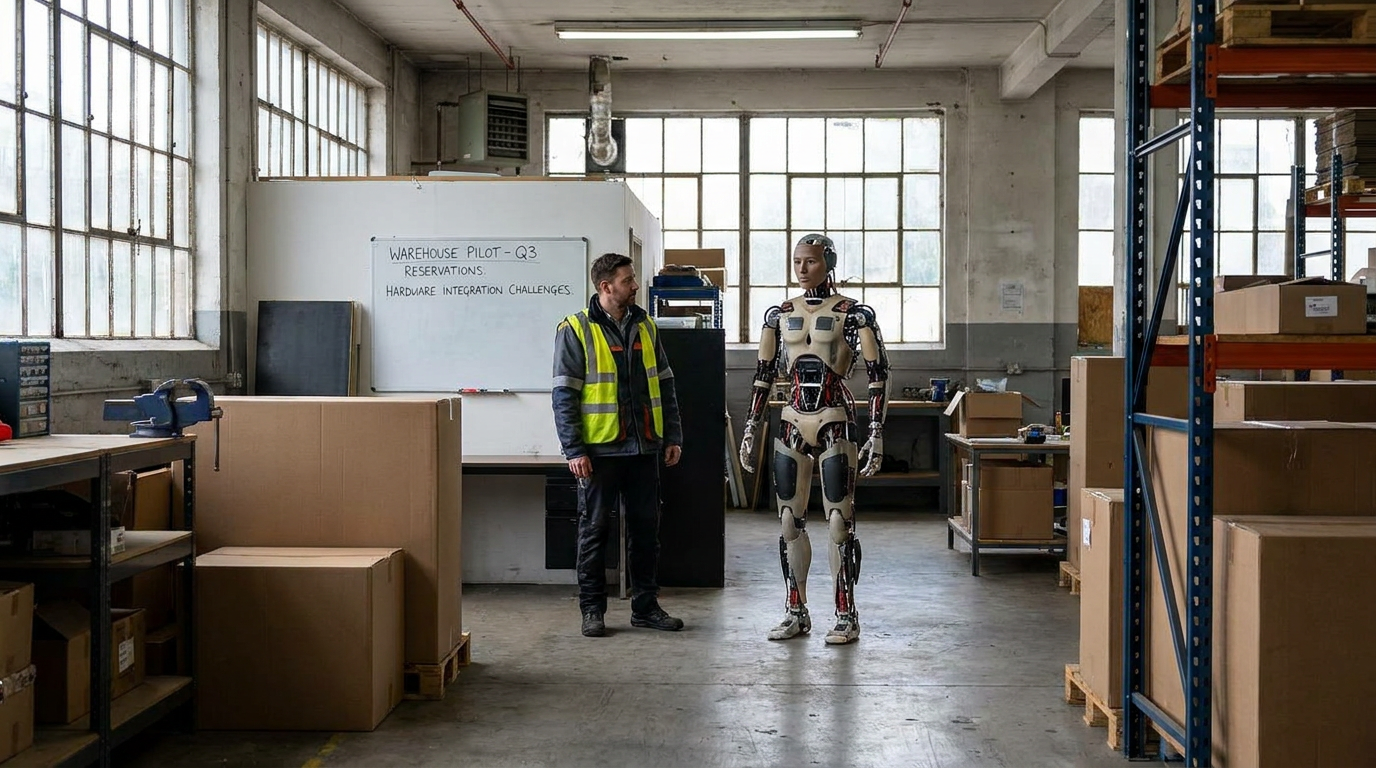
Optimus vs Traditional Industrial Robots: Which architecture fits your 2026 automation goals?
Humanoid architectures like Tesla Optimus trade deterministic speed for environmental adaptability, relying on end-to-end neural networks rather than scripted ROS2 inverse kinematics. Choose fixed SCARA or Delta arms for rigid, high-throughput tasks over 60 cycles per minute, while reserving humanoids for dynamic facilities requiring multi-task flexibility without redesigning work cells.
While news outlets report Tesla is set to open reservations for Optimus robot later this year, says indust coverage from The San Francisco Standard, underlying mechanics dictate factory fit. Electrek highlights persistent hand dexterity issues pushing broad deliveries back, even as Tech-Insider reports Tesla targeting high-volume production lines. Neural vision processing runs at 20–50 ms inference latency, whereas ROS2 controllers execute trajectory loops in under 2 ms.
Humanoid form factors fail in high-payload continuous palletizing. Moving 25 kg loads continuously drains battery packs within three hours and degrades joint thermal limits. Fixed articulated arms execute continuous heavy cycles indefinitely at sub-millimeter precision. Use humanoids for variable, low-payload light assembly across legacy layouts. Stick to standard SCARA or Delta arms for high-speed line operations. Reference an industrial robotics automation complete guide to balance payload tolerances against your operational throughput goals before signing purchase orders.
| Metric | Tesla Optimus Architecture | Traditional Industrial Robot |
|---|---|---|
| Control System | End-to-End Vision Neural Network | Deterministic ROS2 Kinematics |
| System Latency | 20–50 ms inference loop | 1–2 ms real-time bus |
| Repeatability | ±5.0 mm vision-guided | ±0.01 mm encoder-matched |
| Payload Limit | 10–20 kg intermittent | 50–1,000+ kg continuous |
| Work Cell Cost | Low structural setup | High safety guarding cost |
How do you prepare your warehouse for humanoid robotics hardware integration?
Preparing a facility for humanoid robotics requires upgrading legacy network infrastructure, standardizing optical baseline illumination, and deploying micro-edge servers. You must establish deterministic sub-20ms wireless latency, isolate high-throughput vision streams, and install auxiliary hardware telemetry to maintain absolute spatial tracking across dense, dynamic warehouse floors.
Our edge AI agent deployment follows a rigid 45-day execution plan. Days 1 through 15 cover spatial mapping and RF site surveys. Days 16 through 30 involve mounting local edge hardware, while Days 31 through 45 handle full-capacity stress testing. While Tesla is set to open reservations for Optimus robot later this year, says indust analysts, facilities relying on legacy Wi-Fi will choke on real-time video telemetry. You need private 5G routers. Configure your gNodeB settings for QCI 6 QoS prioritization, set channel bandwidth to 80 MHz on sub-6 GHz bands, and reserve a dedicated 100 Mbps uplink per robot.
Lighting variances cause immediate edge perception bottlenecks. During our last vision-system deployment, natural sunlight shifts through high-bay windows dropped object-detection confidence down to 38%, locking up autonomous transport units. We resolved this failure by installing overhead 850nm active infrared illuminators and matching global shutter camera exposure settings directly to 120 Hz LED pulse frequencies.
Finally, tall steel storage racks generate severe RF multipath interference that degrades standard ultra-wideband positioning. Relying solely on onboard visual odometry introduces cumulative drift over long aisle corridors. Building a custom PCB design for tracking that combines a high-precision 6-axis IMU with a sub-GHz LoRaWAN transceiver provides continuous, deterministic ground-truth positioning across your entire facility footprint.
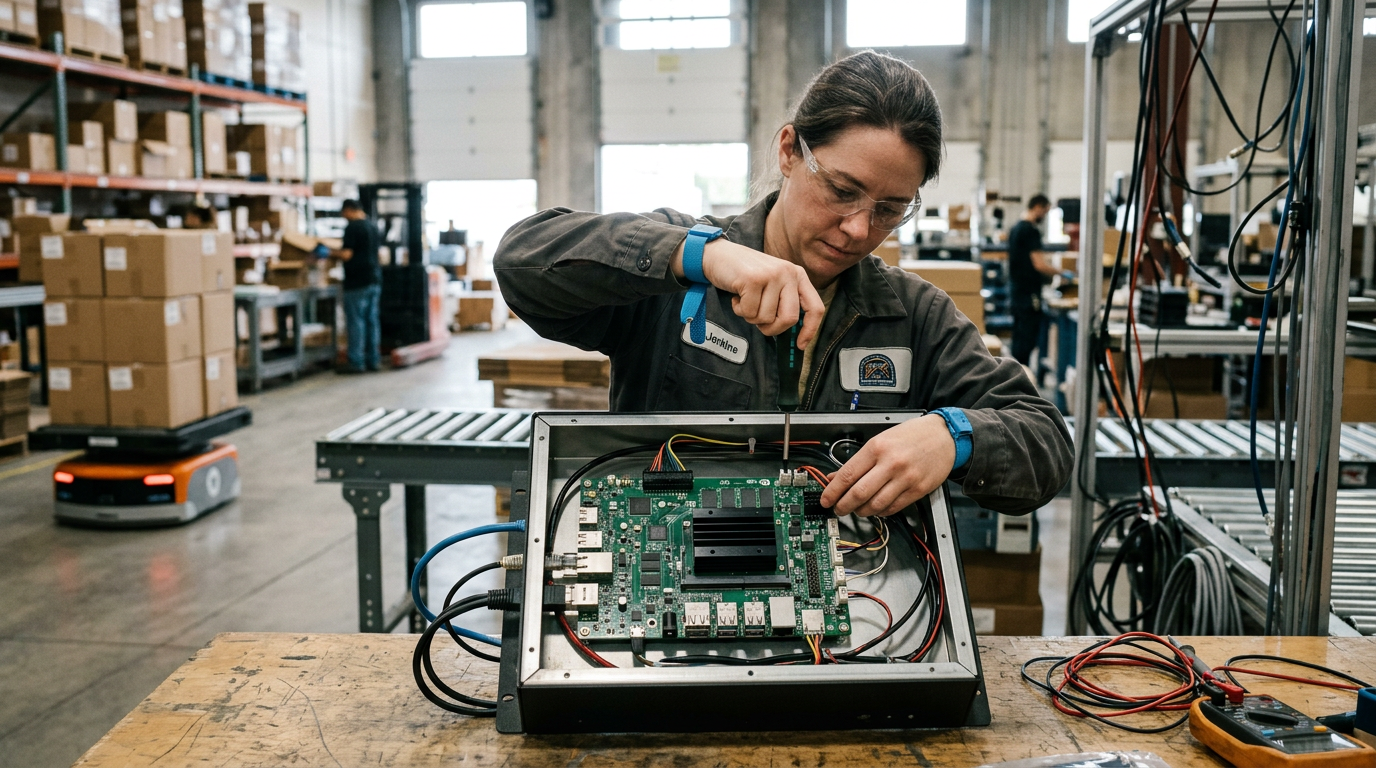
Why might the Tesla Optimus 2027 delivery delay ruin your current automation roadmap?
Holding your facility’s automation budget for Optimus creates immediate opportunity costs. Delays push practical delivery to late 2027, primarily because fine-motor end-effector dexterity remains unresolved. Freezing current upgrade cycles leaves immediate throughput gains on the table while waiting for unvalidated general-purpose hardware.
The Gap Between Demos and Production Rigor
Even though reports from The San Francisco Standard state that Tesla is set to open reservations for Optimus robot later this year, says industry experts, pre-ordering is not deploying. A reservation deposit buys a queue spot, not operational uptime. As Electrek reported when Tesla pushed Optimus deliveries to late 2027, hands are still a problem. Controlled stage demos showing block sorting do not translate to 99.9% repeatability in unstructured industrial spaces. Actuators in multi-articulated hands overheat under continuous duty cycles, and vision models struggle under fluctuating plant lighting. Industry coverage from Tech Insider details ambitious long-term scaling targets, but active production lines cannot risk downtime on unproven wrist torque and sensor drift.
Who Should Invest in Proven Hardware Today
Do not pause your automation budget if your facility requires sub-millimeter positioning accuracy, payloads exceeding 10 kg, or control loop latencies below 5 ms. Traditional SCARA systems, Delta robots, and fixed 6-axis cobots provide deterministic performance today. Delaying equipment integration for two years guarantees lost throughput. Build your automation roadmap on battle-tested hardware, and evaluate general-purpose humanoid platforms only after real-world field metrics demonstrate thousands of continuous, unassisted operating hours.
How can university students simulate Optimus kinematics for FYP projects?
University students can simulate Optimus kinematics by coupling ROS2 MoveIt2 inverse kinematics solvers with physics engines like Nvidia Isaac Sim. By feeding simulated RGB-D point clouds into pose-estimation networks, you mirror humanoid vision-based grasping, mapping camera pixels directly to 3D joint trajectories in real time with low latency.
Vision-based grasping uses a 6-DOF transformation matrix to convert spatial point clouds into finger joint commands. Electrek reported that complex hand integration pushed Optimus deliveries back, proving how difficult fine motor actuation remains in production. For your Final Year Project, your hardware architecture dictates whether you execute spatial tensors onboard or suffer severe bus latency.
When selecting edge hardware, evaluating Nvidia Jetson Orin vs ESP32 defines your system’s processing ceiling.
| Parameter | Nvidia Jetson Orin Nano | ESP32-S3 |
|---|---|---|
| AI Compute | 40 TOPS (INT8) | 0.0003 TOPS |
| ROS2 Support | Native Ubuntu / ROS2 Humble | Micro-ROS bridge only |
| Inference Latency | 14 ms pipeline | System crash / OOM |
Single-board computers collapse when running heavy neural networks alongside inverse kinematics. Watch for these hardware failure modes during physical testing:
- Memory exhaustion caused by buffering dense 3D point cloud data above 30 frames per second.
- Thermal throttling that spikes visual-servoing control loops beyond 100 ms, causing missed grasps.
While Tesla is set to open reservations for Optimus robot later this year, says indust reporting, student budgets must balance raw compute against unit costs. Skip cheap microcontrollers for spatial kinematic vision tasks. Choose an Orin board to process local neural workloads without losing trajectory tracking precision.
The humanoid automation hype cycle is deafening, but your engineering decisions must remain grounded in physics and capital expenditure. Map your facility’s current floor-to-ceiling payload transfer times first. You know you are ready for bipedal integration when your simulation shows a humanoid matching your existing AGV throughput without requiring safety cage modifications.
Optimus will not fix a broken warehouse management system. If your facility still relies on paper picking lists or your FYP lacks a rigid kinematic model, ignore humanoid hardware entirely. Stick to wheeled AMRs.
Frequently Asked Questions
When will Tesla Optimus be available for purchase?
Tesla is set to open reservations for the Optimus robot later this year, with full production models expected to roll out by 2026. If you want to integrate these humanoid units into your industrial operations, you must start evaluating your current automation infrastructure now. Preparing your facility early ensures your custom AI and IoT systems can seamlessly communicate with the new hardware.
How much will the Tesla Optimus robot cost?
Elon Musk estimates the Optimus robot will eventually cost between $20,000 and $30,000 once it reaches high-volume production. However, your initial deployment costs will be higher due to the necessary software integration and facility upgrades. You must budget not just for the hardware, but for the end-to-end AI automation and IoT infrastructure required to make the robot function effectively in your specific environment.
What are the main differences between Optimus and traditional industrial robots?
Optimus is a bipedal, humanoid robot designed for general-purpose tasks, whereas traditional industrial robots are fixed-base machines programmed for single, repetitive actions. You will find that Optimus leverages advanced AI and vision systems to navigate dynamic environments and handle varied objects. To maximize this flexibility in your own operations, you need robust software integration that connects the robot’s neural networks directly to your existing IoT and automation frameworks.
Why are Tesla Optimus deliveries delayed to 2027?
Deliveries are delayed to 2027 because Tesla needs more time to refine the robot’s AI training and scale up their complex hardware manufacturing. You must understand that achieving reliable, autonomous behavior in unpredictable industrial environments requires massive amounts of real-world data. While waiting for these commercial units, you can begin upgrading your facility’s IoT networks and custom automation systems so your infrastructure is fully prepared for deployment.
How can students build humanoid robot projects for their FYP?
You can build a humanoid robot for your Final Year Project by starting with modular hardware kits and open-source AI frameworks like ROS. Focus your efforts on mastering the end-to-end integration of sensors, actuators, and IoT connectivity rather than manufacturing custom parts from scratch. We can help you design and deploy these cutting-edge robotics projects, ensuring your software and hardware work together seamlessly to meet your academic requirements.
Sources & References


